
What Digital Leaders Need to Innovate with AI Adoption: Insights from 21 Nonprofit Senior Staff

Key Takeaways
- The Readiness Gap: There’s often a large gap between stakeholders’ interest in AI adoption and readiness to take action.
- The Priorities Gap: Testing AI tools is easy, but more productive when there’s an AI strategy in place.
- Peer Support: A peer community is crucial to restoring energy, ideas, and innovation to lead organizational change.
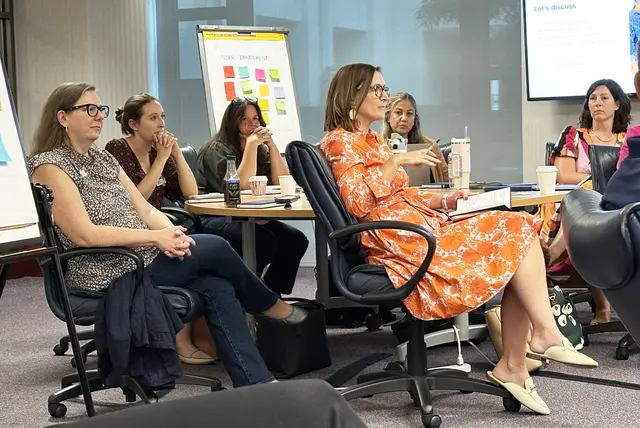
Recently, we gathered 21 senior nonprofit leaders from National Education Association, Ohio Legal Help, Easterseals, OCEANA, Sierra Club, and more for a summit dedicated to navigating the AI revolution at their organizations. Over 8 hours and countless cups of coffee, we discussed the challenges digital operations, IT, marketing and communications, and executive leaders face as they bridge the gap between AI promise and adoption.
Here are their biggest internal challenges, and the solutions that make all the difference.
The Readiness Gap
Challenge: The Chasm Between Theory & Practice
Most summit participants reported that their organizations are cautiously enthusiastic about using AI to further their mission. Enthusiasm is fueled by growing personal experience with AI tools like ChatGPT for completing difficult tasks quickly; caution due to the significant ethical, ecological, and legal concerns in adoption.
Staff charged with leading AI adoption are getting caught between that enthusiasm and caution. They report pressure from boards, funders, and sometimes executive leadership to show quick progress. But when the very nature of work is changing—the when, where, and how of digital operations—digital leaders need the time and space to understand where key stakeholder groups stand on their approach to AI at work.
As one director at a national education nonprofit explained, “Leadership wants to see us moving on AI, but my staff are really concerned about their jobs and the environmental impact of using AI.”
Solution: Conducting Internal Research
To help close the gap between theory and practice, give your senior leaders time to lead internal research. We recommend the following:
- Conducting stakeholder interviews to uncover shared goals and concerns of adopting AI at work
- Stakeholder mapping to analyze findings by key audience groups, including staff, executive leadership, board members, and funders
- Building an inventory of tools colleagues are already testing at work, with notes on tool purpose and outcomes to date
Having a comprehensive view of AI adoption at your organization will prepare you to define next steps that most stakeholders will support.
The Priorities Gap
Challenge: Balancing Strategy Development & Tool Testing
Courses and cheat sheets on using specific AI tools are easy to find, and they produce results that are expansive and exciting. Scale up data collection! Eliminate tedium and friction! Write more, do more, maximize creativity!
The AI sales pitch plays to our desire for silver bullets and immediate gratification. And the adoption rate of AI chatbots for content editing means we’re close to a new normal of having a plan as quickly as ideas are typed.
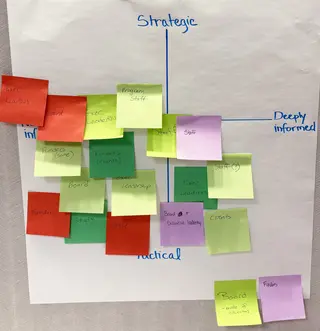
But our summit participants were clear: they want to test out new tools, and then have time to reflect and plan for a broader approach. As in program or business development, a data-driven AI adoption plan helps teams work more effectively and efficiently toward achieving shared goals. (It also provides guardrails against highly embarrassing, headline-grabbing errors.)
It’s easy to forget that human creativity and considerate planning don’t operate at the speed of AI—and that AI speed doesn’t guarantee successful outcomes.
Solutions
- Form a cross-team working group to bring internal technical, legal, and user experience expertise together
- Define a narrow pilot to test using an AI tool for a task staff would prefer not to do (running manual code tests, keeping decentralized documentation up to date, etc.)
For both solutions, make sure you have defined goals and deadlines before starting. They’ll help prevent a quest for perfection defeat making progress.
Peer Support
“I keep being struck by the importance of a community, especially when tackling a new technology tool that comes with so much uncertainty.”
Summit Participant
Challenge: Feeling Isolated
The stop-start cycle our digital leaders were experiencing didn’t just impact their ability to do their jobs. Being at the center of these tensions was isolating. Reflecting on the day, one summit participant shared: “I keep being struck by the importance of a community, especially when tackling a new technology tool that comes with so much uncertainty.”
She’s not alone in feeling the impact of being part of a community, even a temporary one. In a Harvard Business Review report, two psychology researchers found that “cultivating a network of allies…can provide mutual support in creating positive change to improve performance.”
Solution: Expanding (Human) Networks
More than research and resources, digital leaders need a chance to connect, in person, with nonprofit peers. They need the opportunity to step out of their regular day, and be away from the office. They need new faces, a new setting, and an approved out-of-office message so they can step away from their screens and focus solely on planning and problem-solving. Look for:
- In-person conferences like NTC that attract nonprofit professionals working at the intersection of technology, strategy, and change management
- Professional groups with local meetups, like The Bureau
- Sector-specific mentorship programs, such as ASAE’s ReadyMe or Diversity Executive Leadership Program for association senior leaders.

